State management is a crucial part of building scalable and maintainable Angular applications. As applications grow, managing data flow and synchronization between components becomes challenging.
Historically, Angular developers relied on services and observables for state management. While effective for smaller apps, these approaches become harder to maintain as complexity increases. That’s where NgRx and the new Angular Signals come in.
In this guide, we’ll explore:
- When to use them separately.
- What NgRx and Angular Signals are.
- How each handles state management.
- How to combine them for optimal results.
Understanding State Management in Angular
In simple terms, state management is how data is stored, processed, and shared across your application.
- Small apps → Simple component communication (inputs/outputs or services).
- Large apps → Risk of unnecessary re-renders, out-of-sync data, and debugging headaches.
To handle complexity, developers turn to:
- NgRx → Best for large-scale, shared, and predictable state.
- Angular Signals → Best for lightweight, reactive, component-level state.

NgRx – The Redux-Style Approach
NgRx is a state management library built specifically for Angular, following the Redux pattern. It enforces unidirectional data flow and immutable state changes.
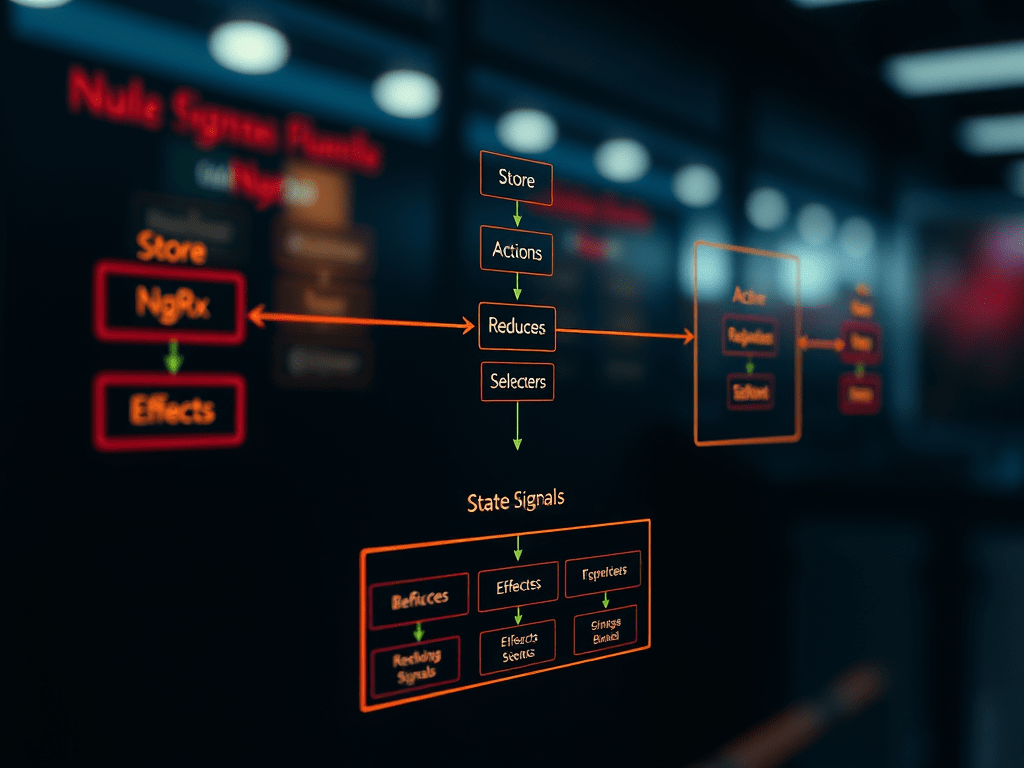
Core Concepts in NgRx:
- Store – Centralized container for your application state.
- Actions – Events describing state changes.
- Reducers – Pure functions to update the state.
- Selectors – Query parts of the state.
- Effects – Handle side effects like API calls.
Why Use NgRx?
- Useful when caching or controlled updates are needed.
- Predictable state changes.
- Great for debugging & testing.
- Ideal for apps with shared, global state.

Angular Signals – A New Reactive Primitive
Angular Signals, introduced in Angular 16, provide a simpler way to manage state without all the NgRx boilerplate.
Key Features:
- Perfect for component-local state.
- Reactive and integrated with Angular’s change detection.
- No need for actions, reducers, or selectors.
- Uses mutable state with fine-grained reactivity.

When to Use Signals
- UI updates that must be fast and responsive.
- Small or medium-sized components.
- Feature modules that don’t need global store access.
Combining NgRx and Angular Signals
While NgRx handles global state well, it can sometimes trigger unnecessary re-renders.
By pairing NgRx with Angular Signals:
- Signals → Handle fast, local UI updates.
- NgRx → Manages shared, global application state.

This way:
- Signals ensure minimal UI updates and smoother performance.
- NgRx keeps your data consistent.
Best Practices
Use NgRx for:
- Complex, shared state.
- Large applications.
- State persistence & debugging.
Use Signals for:
- Component-local or feature-level state.
- Performance-critical UI elements.
Combine both for maximum scalability and performance.
Conclusion
NgRx and Angular Signals are not competitors—they’re complementary tools.
- NgRx offers structure, predictability, and scalability.
- Signals provide lightweight, reactive, and easy-to-use state handling.
For optimal results:
- Use NgRx for global state.
- Use Signals for local state.
By blending the two, you get the best of both worlds—performance, scalability, and maintainability.
References
Journal
Alessandro, R. and Giulia, B., 2024. AI-Enhanced Cybersecurity Proactive Measures against Ransomware and Emerging Threats. Innovative: International Multi-disciplinary Journal of Applied Technology, 2(11), pp.77-92.
Boffin, H.M., Vinther, J., Bazin, G., Huerta, D., Jung, Y., Lundin, L.K. and Stellert, M., 2024, July. ESO’s new generation of Exposure Time Calculators. In Observatory Operations: Strategies, Processes, and Systems X (Vol. 13098, pp. 769-774). SPIE.
Moller, D., Ruf, C., Linnabary, R., O’Brien, A. and Musko, S., 2021, July. Operational airborne gnss-r aboard air new zealand domestic aircraft. In 2021 IEEE International Geoscience and Remote Sensing Symposium IGARSS (pp. 1284-1287). IEEE.
Rejkuba, M., Hainaut, O.R., Bierwirth, T., Pruemm, M. and Weiss, A., 2024, July. Time allocation and long term scheduling of ESO telescopes at La Silla Paranal Observatory. In Observatory Operations: Strategies, Processes, and Systems X (Vol. 13098, pp. 536-551). SPIE.
Yang, C., Mao, K., Guo, Z., Shi, J., Bateni, S.M. and Yuan, Z., 2024. Review of GNSS-R technology for soil moisture inversion. Remote Sensing, 16(7), p.1193.
Zhao, J. and Wang, X., 2021. On the efficiency of multi-beam medium access for millimeter-wave networks. IEEE/ACM Transactions on Networking, 30(4), pp.1469-1480.
Zimmerle, C., Gama, K., Castor, F. and Filho, J.M.M., 2022, May. Mining the usage of reactive programming APIs: a study on GitHub and stack overflow. In Proceedings of the 19th International Conference on Mining Software Repositories (pp. 203-214).
Websites
auth0.com, 2025. How Does Ngrx Work [Online]. Available at: https://auth0.com/blog/state-management-in-angular-with-ngrx-1/. [Accessed on: 26.02.2025]
javascript.plainenglish.io, 2025. State Management with Ngrx & Angular Signals [Online]. Available at: https://javascript.plainenglish.io/mastering-state-management-in-angular-with-ngrx-signalstore-6b856abef858. [Accessed on: 26.02.2025]
Posts

About the Author: Anish Giri is a full-stack developer and technical writer passionate about building scalable Angular applications. He shares practical guides, tips, and insights for developers on Girianish.com.
 girianish.com
Leave a comment